Cascade classification of dermoscopic images of skin neoplasms with controlled sensitivity and external clinical validation
Abstract
Aim. To compare deep learning architectures and classification schemes for dermoscopic images of skin neoplasms and to assess their generalizability when transferred from open international datasets to independent clinical datasets of Russian practice.
Materials and methods. Four architectures (ViT-B/16, Swin-S, ConvNeXt-S, EfficientNetV2-S) were compared in three schemes: binary (malignant/benign), single-stage four-class, and two-stage cascade (binary triage with a tunable threshold – differentiation of MEL / SCC / BCC). All models were initialised with ImageNet weights, trained on a union of open ISIC Archive datasets, and evaluated on an internal held-out sample and two clinical datasets (Melanoscope AI; Sechenov University). The significance of differences was tested using DeLong, McNemar, and stratified bootstrap tests.
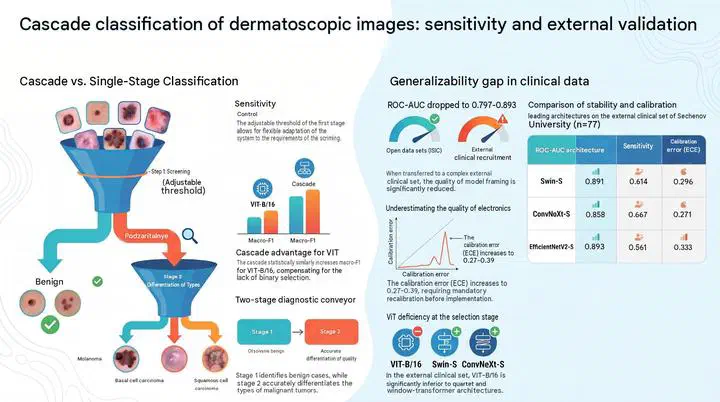
Results. On the internal sample, the ROC-AUC of the binary stage was 0.952–0.966; on transfer to the most challenging external clinical dataset it drops to 0.797–0.893, sensitivity to 0.53–0.67, and the calibration error (ECE) rises from 0.02 to 0.27–0.39 with underestimation of malignancy. Only the deficit of ViT-B/16 at the binary triage stage was statistically confirmed; at the nosological differentiation stage no architectural advantages were identified given the available volume of malignant cases. The cascade gain was significant only for ViT-B/16.
Conclusion. Cascade decomposition with a tunable threshold provides sensitivity control unattainable in single-stage classification. The persistent generalisation gap necessitates external clinical validation and recalibration before deployment.